

Introduction
In today’s construction environments, safety is no longer treated as secondary to productivity, scheduling, or project execution. On complex electrical construction projects like those for critical infrastructure, transportation, and health, safety must be built into every step of the work, beginning with planning.
At UpTime Electric, we understand the importance of safety that starts well before the first crew arrives on site. We know that effective safety planning impacts everything from manpower and training to equipment, sequencing, shutdowns, and coordination with other trades. For electrical contractors, the objective is not simply to comply with requirements but to create a predictable environment where our work can be executed safely and efficiently, even as project conditions evolve.
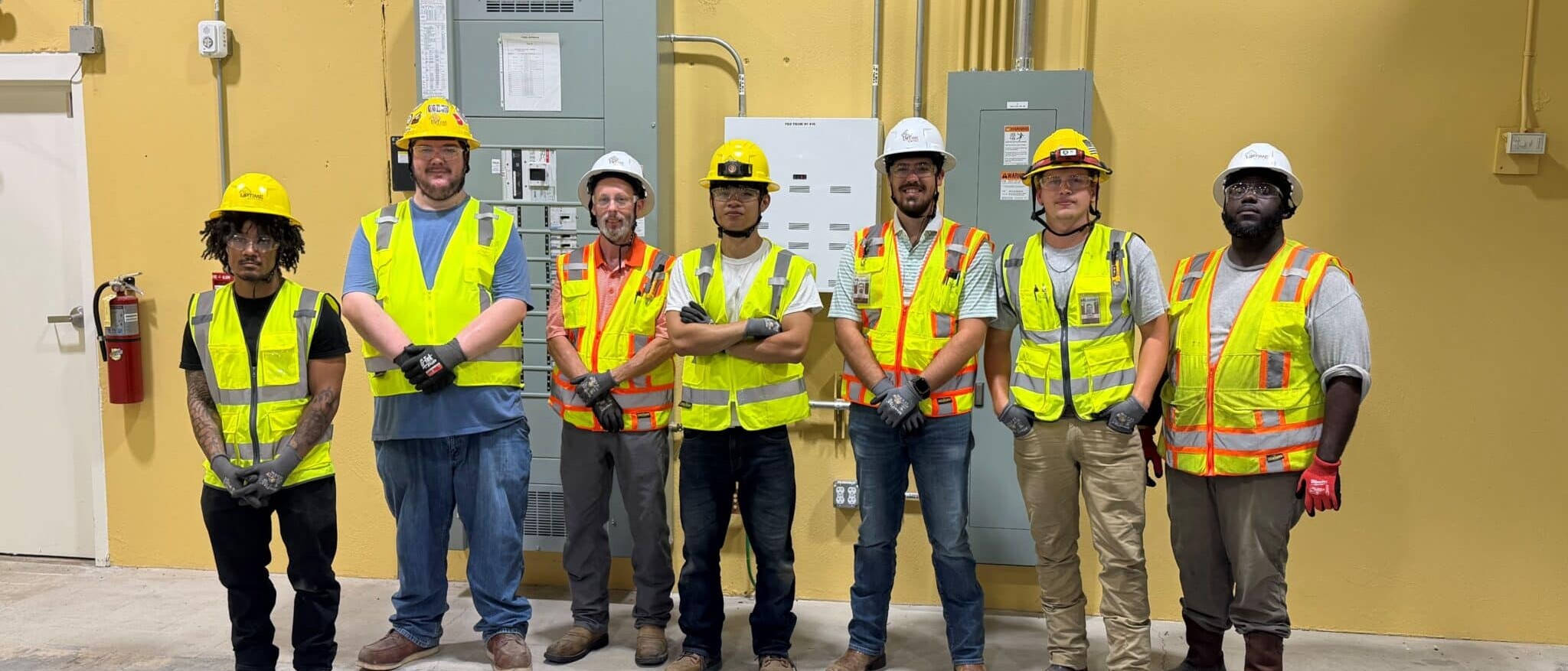
Safety Planning in Preconstruction
We’ve seen time and again that the most important safety decisions are made before construction even begins. Although projects are becoming increasingly complex, contractors are also afforded more opportunities to evaluate the work prior to field work. GCs and trades regularly use digital coordination, Building Information Modeling (BIM), detailed scheduling, and preconstruction planning to successfully identify potential conflicts and understand how work will be sequenced. Alongside design, budgeting, and scheduling, our ability to identify and address potential safety issues improves when these tools are used effectively.
As part of effective preconstruction, we ask crucial questions like: What training will our crew need? Will the project involve lifts, fall protection, confined spaces, or lockout/tagout? What are the owner’s specifications for ladders and other equipment? Will site-specific safety personnel be required? How will electrical shutdowns be coordinated?
These questions have direct implications for cost, manpower, and schedule. Being able to determine these answers early allows safety coordinators to incorporate site-specific safety needs into the project plan. However, when contractors fail to resolve these questions before mobilizing, these issues regularly become disruptions.
That distinction is particularly important in electrical construction for complex facilities and critical infrastructure, where schedules are stringent and safety is paramount.
Consistency in Standardization
Safety programs are most effective when employees know what to expect regardless of the project they’re working on. At UpTime Electric, that means maintaining consistent safety standards across job sites while adapting individual programs and training to the specific hazards of each project.
That consistency makes it easy for personnel to move fluidly between projects. We’ve found that when the underlying safety processes remain the same and workers don’t have to relearn the company’s expectations every time they change job sites, we’re able to maintain a higher level of safety and productivity. Then site-specific requirements can be layered on top of an established, strong foundation.
The result is a safety culture that is consistent without being inflexible. As our professionals grow accustomed to new safety measures, we see that productivity increases and that results don’t come from reckless speed but from consistency and practice.
Safety as a Field-Level Responsibility
No safety leader can be everywhere all the time. With multiple projects and hundreds of employees working across different sites, effective safety management depends on the people closest to the work.
We empower every employee from apprentices up with the authority to stop work if they identify an unsafe condition. The principle is straightforward: any person who sees a hazard should have the authority to raise the concern.
This stop-work authority helps to create accountability in both directions: Supervisors are responsible for responding to concerns, while employees are empowered to speak up. If an issue can’t be resolved at one level, it gets escalated until it can be.
Our all-hands approach is particularly important on multi-trade electrical construction projects where our crews are working alongside mechanical, HVAC, plumbing, and other contractors. A hazard created by one trade can affect everyone on site. Not only are we responsible for the safety of others, but we encourage our tradesmen to identify any safety risks, even if it’s not our team.
Effective safety cannot stop at the company boundary. Every single person on a site has a role in protecting the people working around them.
Training That's More Than Compliance
Effective safety training can no longer simply be a matter of completing required courses and checking a box. Our approach at UpTime is shaped in part by the experience of our leadership and management teams who have all had hands-on field experience. That perspective helps connect safety requirements and training with the conditions workers actually encounter on an electrical construction job site.
We’ve found that extending training past compliance helps change the safety conversation. Instead of telling our field professionals that a particular procedure is required according to OSHA or a safety manual, we focus the discussion on why procedures exist and what risks they are designed to control. This distinction has proven to have a meaningful impact on employee buy-in.
Effective safety training also requires that it be continuous. Daily safety briefings, job-specific analysis, recurring training, and field observations all help over time to reinforce expectations. Technology supports our effort by allowing managers to track training requirements and ensure all workers have the qualifications necessary for the job they’re performing.
The objective of safety training cannot simply be to train people once; it must build safe practices into the routine of the job.
Precision for Critical Infrastructure
Electrical safety becomes even more consequential when working around critical power systems.
The safest way to perform electrical work is to deenergize the equipment. UpTime Electric maintains a policy against working on energized circuits except in the most extreme circumstances, and we use LOTO (lockout/tagout) procedures to ensure safety and individual control over electrical energy.
Critical facilities, however, don’t always have the luxury of unlimited shutdowns. Data centers, airports, hospitals, and other mission-critical environments may have systems that cannot simply be taken offline. In these cases, electrical construction work must be coordinated around narrow windows, with multiple trades needing to be involved.
These challenging requirements make planning essential. A detailed method of procedure can establish the sequence of work, identify the hazards, define mitigation measures, and establish responsibilities before shutdown begins. Daily safety briefings then reinforce these requirements at the field level. Careful planning and a strong, established safety culture can help prevent unsafe decisions when under schedule pressure.
Conclusion: Building a Culture that Scales
Safety programs have evolved significantly over the past several decades, and we are going to continue to see increased safety standards. While technology may change how projects are coordinated and workforce requirements may shift, one fundamental principle remains constant: a safe project does not happen by accident.
Safety in electrical construction happens when it is considered during every step, from estimating and preconstruction through training and job-site daily briefings.
At UpTime Electric, our goal is straightforward: make safety part of how the work gets done, not something added to the work after the plan is already in place. We understand that the strongest safety culture is not one that slows a project down but one that makes safe execution part of a successful design.